Product Description
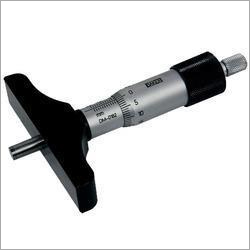
With the utilization of cutting edge technology in all our procedures, we as a predominant exporter, manufacturer and supplier are occupied with offering a recognized array of Depth Micrometer. Being a quality-arranged Depth Micrometer, we guarantee our customers that these Products are very noteworthy and best in quality. These micrometers are made at our all around prepared manufacturing unit using fine quality material and refined innovation in adherence to characterized quality measures of global market.
Robust Construction for Precision TasksBuilt from hardened stainless steel and finished with satin chrome plating, this depth micrometer is engineered for reliability and longevity. The broad, stable base ensures accuracy in various testing environments, making it suitable for industrial and laboratory applications alike.
Interchangeable Rods for Versatile MeasurementSupplied with multiple rod lengths (ranging from 0-25 mm up to 150 mm), this tool easily adapts for measuring different depths. The quick-change feature enhances efficiency for users requiring diverse measurements within the same application.
Precision and Ease of UseThis analog instrument delivers accurate measurements with a graduation and resolution of 0.01 mm. Key user-friendly features-such as the ratchet stop and locking screw-facilitate consistent, error-free operation, while the anti-glare finish improves visibility in varied lighting.
FAQ's of Depth Micrometer:
Q: How do I use the depth micrometer to measure a groove or step?
A: Select the appropriate rod based on your required depth range and securely install it in the micrometer. Place the wide, flat base on the surface and gently lower the measuring spindle into the groove or step until contact is made. Lock the spindle with the screw, then read the measurement from the analog vernier scale.
Q: What are the main benefits of using a depth micrometer with interchangeable rods?
A: Interchangeable rods allow for greater versatility, enabling precise measurements across a broad range (0-150 mm) without the need for multiple separate tools. This optimizes efficiency and reduces equipment costs for laboratories and industrial settings.
Q: When should I use a manual depth micrometer instead of a digital model?
A: A manual depth micrometer is ideal when analog readings are preferred, or when working in environments where digital electronics could be compromised by humidity, dust, or temperature variations. Its mechanical design also ensures durability and instant responsiveness.
Q: Where is this depth micrometer most effectively used?
A: It is widely used in industrial material testing, quality assurance laboratories, machining workshops, and research facilities in India and worldwide. Its robust design and precision make it suitable for both field and laboratory work.
Q: What is the process for calibrating the depth micrometer?
A: Before use, check zero alignment with the base on a reference flat surface. Insert a rod and ensure the vernier scale reads zero when the spindle is flush with the base. For accuracy, periodic calibration against certified gauge blocks is recommended.
Q: How does the anti-glare satin chrome finish improve the user experience?
A: The satin chrome finish significantly reduces reflections and glare, making the vernier scale easier to read, especially in brightly lit or industrial environments, thereby helping prevent eye fatigue over extended periods of measurement.





 Send Inquiry




 Send Inquiry

